

Building the Intelligent Web: Jonathan Arena on Design at the AI Frontier
New Generation's Jonathan Arena on the design leader to founder transition, why e-commerce is the most valuable internet real estate, and what it means to design when the primitives are all new.


A couple of years ago, Jonathan Arena was working on a book about interfaces. He wanted to map the evolution from physical dials and switches to touchscreens, and then try to sketch what might come next. But the book was really a way into a bigger question: if the medium itself is shifting, what should design schools be teaching?
We’d been circling that idea for a while: what the curriculum would look like, who would teach it, whether any program could realistically keep up with how quickly things were moving. Eventually, he realized the chapter he most wanted to write didn’t exist yet. The problems were still unfolding. So he set the manuscript aside and went to work on one of them.
At that point, Jonathan had spent more than fifteen years building products at Facebook, Cruise, and Patreon, rising into senior design leadership roles along the way. By most measures, he was in a comfortable stretch of his career: work he enjoyed, strong compensation, and a clear path to the next leadership role and the one after that.
Most people would have remained on that track, but Jonathan looked towards a different one. Today he’s the co-founder of New Generation, a company building AI-powered storefronts for retail brands. The path from design education to e-commerce infrastructure sounds like a leap, until you hear him describe the lily pads that connected the two.
What we cover:
Why Jonathan left design leadership to start a company at this specific moment in tech
How a book about interfaces led him from design education to e-commerce
What New Generation is building with Kepler and why current e-commerce websites can’t keep up
How brands are reacting to agentic commerce and why change management is the real bottleneck
The emergence of the “prototype-native designer” and agents as synthetic user research
Why this is the most exciting time to be a designer, and what that demands
Are you a designer building something new, or know someone who is?
We’re always looking for more designer founders to feature, invest in, or partner with.
“I couldn’t resist participating in this moment as a builder”
Jonathan’s been searching for two things throughout his career: complexity and new interfaces. “The intersection of new business models and net new interfaces is my happy place,” he says. “I am on a lifelong quest to continually try to position myself in that aperture.”
At Facebook, he designed key aspects of the photos experience used by billions of people and later led the design team for Portal, the company’s first AI hardware product, where they built a new end-to-end operating system. At Cruise, he managed teams working on early versions of the driverless rider experience and AI tooling suite. At Patreon, he led Consumer Product Design across mobile, web, community, and the design system.
In a recent talk at South Park Commons, he traced that thread back to middle school, when he built a snowboard repair shop in his parents’ garage, got Burton to send him free gear, and later counterfeited a press pass to sneak into the US Open of Snowboarding. The takeaway from those early experiments: “You can just do things.”
For a lot of his career, that energy lived inside other people’s organizations. He’d been carrying a list of 150 startup ideas for years, but didn’t quite have the right convergence of timing + partner + problem.
The timing arrived with what he describes as a new epoch, similar to the mobile ramp-up of 2011 that produced a generation of companies, followed by a decade spent building out those primitives. Now the primitives themselves are resetting.
“Because we’re all kind of resetting and the technology is all new and the heuristics are all new, it’s almost easier now to excuse yourself and say: nobody’s further ahead than I am in exploring this stuff. I might as well be at that efficient frontier.”
The partner arrived through grad school connections: Adam Behrens, his co-founder, who studied philosophy and economics and aligned quickly with Jonathan on a shared thesis about AI reshaping the open web.
And the problem emerged from a deep exploration of design education. Jonathan’s been involved with RISD since graduating and co-founded HarvardxDesign, a design conference now in its thirteenth year. As he dug deeper into how interfaces evolve, and what designers would need to understand next, a pattern emerged. A handful of unresolved questions kept surfacing. One, in particular, wouldn’t go away: what happens to the e-commerce website?
Online shopping architecture hasn’t meaningfully changed in twenty years: search bar, filters, product grid, detail page, checkout. And yet those pixels carry enormous economic weight; Stripe’s checkout alone processes over a trillion dollars a year. It’s a massive business opportunity, and it sits squarely at the intersection of Jonathan’s long-running obsession: making software work how people want it to work.
The design school remains a long-term ambition. “If I really squint at what’s the professor that I want as a student, it’s somebody who’s summited Everest a bunch of times.” Founding a company, he says, is the best expression of a designer’s intuition: the chance to put it to the test without fitting it underneath other people’s ambition.
“As a founder, you are sailing your own boat in a big ocean and you can go wherever you want and put your intuition to the test.”

What New Generation is building
New Generation’s platform, Kepler, starts from a straightforward observation: e-commerce websites weren’t designed for how people (and increasingly, AI agents) actually want to interact with them.
On the brand side, the infrastructure is a mess. One cosmetics company New Generation works with has 47 different suppliers touching their website. Managing that ecosystem while trying to sell products is a grind. On the consumer side, keyword search is broken. Finding something specific in a large catalog means opening multiple tabs, clicking through filters, comparing across brands. Thirty minutes spent on what should take thirty seconds.
The fundamental shift Jonathan keeps coming back to: the currency of the internet is changing. It’s now denominated in asking questions. ChatGPT is three years old. Its interaction model (natural language in, structured answers out) is becoming the baseline expectation for how people engage with information. The vast majority of e-commerce websites haven’t adapted to that.
Kepler is New Generation’s answer. It has three core products:
Agent Storefronts structure a brand's site so AI agents can read it, discover products, and display accurate results.
AI Insights surface real-time data on how customers and AI systems interact with products: shopper intent measured through actual conversations rather than inferred from clicks.
Conversational Storefronts let customers use natural language search directly on a brand's site, generating bespoke pages in real time.

The go-to-market is deliberately low-risk for brands. Rather than replacing an existing site, New Generation deploys Kepler as a single AI-powered page on a subdomain, ai.[brand].com. Brands route a small percentage of traffic there, run clean attribution tests, and measure the uplift against their existing experience. If it performs, they roll it out more broadly. If it doesn’t, the core site stays untouched.
In his SPC talk, Jonathan described the concept to a taxi driver in Vegas: “We were explaining our idea and he was like, ‘So you mean websites are stupid?’ And we’re like, ‘Yeah, basically.’”
How brands are reacting
Jonathan has a useful framework for how companies adopt AI, organized by risk exposure:
Tier one is individual, private use. You’re using ChatGPT for your own work. If it hallucinates or gives a bad answer, the consequences are low.
Tier two is team or company use. Slightly more consequential, as you’re trusting AI with organizational work, but still internal.
Tier three is public-facing. You’re trusting an AI service to interact with your customers, on surfaces that directly touch revenue.
There are two types of brands that tend to move first. Incumbent leaders with visionary leadership who want first-mover advantage, and “punch-ups,” nimble challengers using the technology to climb the ladder in their vertical. One example of this is Nike vs On Running.
It’s the middle group that shows the most resistance: brands that have spent 15 years hyper-optimizing conversion funnels, where product detail pages are treated as jewel boxes no one is allowed to touch. It’s difficult for them to imagine putting a generative, non-deterministic interface that hasn’t been approved through five levels of review in front of customers.
Jonathan says this is as much about change management as it is about technology. “If this was an easy thing to do, an obvious idea, then there really wouldn’t be a business opportunity for us.” The combination of education + trust-building + great design results in their moat.
But the math is compelling. Demonstrate even a few basis points of conversion improvement for a retailer doing hundreds of billions in revenue, and the argument makes itself:
“Do you like money? You’re a business. Do you like to spend it less? Do you like to make more of it? Okay, great. Let’s go.”
Designing at the frontier
How do you design features for a product category that barely exists? Jonathan spends roughly half his headspace each week on this.
Figma still has a role, but it’s shifted. It’s now a storyboard for internal alignment rather than the artifact translated into specs. The real work happens in live prototypes. New Generation’s founding designer, Nick, is what Jonathan calls a “prototype-native designer.” Instead of starting with static files, he cuts straight to working prototypes connected to the company’s APIs. He moves fluidly between visual design, front-end engineering, and shipping pull requests throughout the day.
“We’re all just product builders now. It’s the most fun I’ve ever had working because we don’t have to think like ‘that’s not my job, I can’t go there, I’m going to piss somebody off’ anymore.”
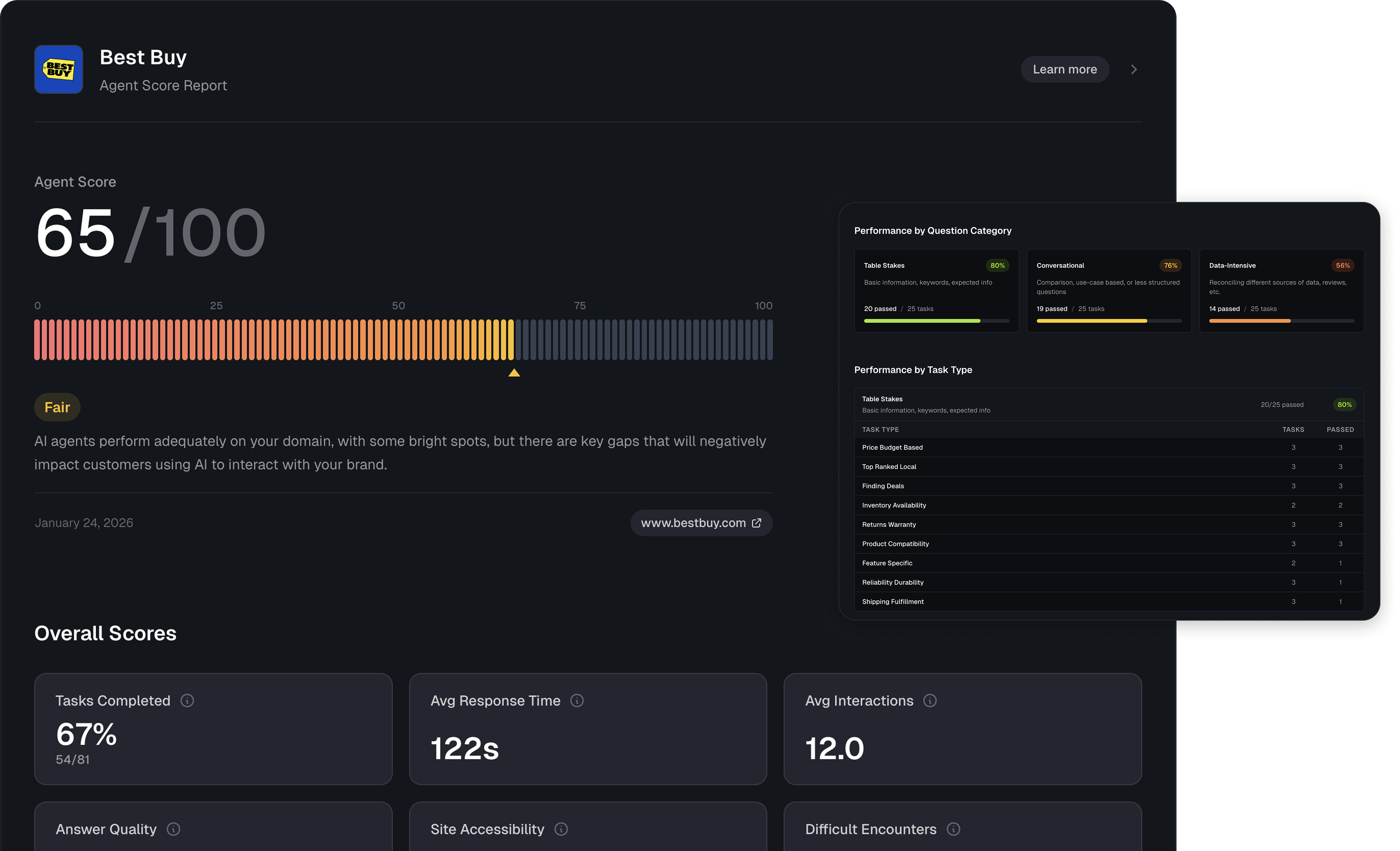
Agent Score grew directly out of this practice. Agents evaluate a brand’s website, another monitoring agent reviews the interaction, and the system generates a report card identifying what worked and what didn’t. Jonathan describes it as a kind of synthetic user research, a glimpse of a future where designing for agentic stakeholders becomes as normal as designing for human ones.
Jonathan himself has been pushed further into the technical side than at any point in his career. “I have learned more about coding and engineering in the past year of this company than in my entire career before.”

“Lucky you”: Jonathan’s advice for designers
The baseline for designers is rising. If you’re completely non-technical, the output you can achieve with AI tools today is dramatically better than what was possible two years ago. That’s great for many use cases. But it doesn’t address the frontier. The people pushing new boundaries, widening the gamut of opportunity for everyone else, are technical. “That’s where we want to be,” Jonathan says. “Not in the center where it’s not consequential.”
His practical advice for designers, drawn from both our conversation and his talk at South Park Commons:
Get a co-founder. You need an actual technical partner to build with: “it’s pretty bad advice to think you can do everything alone.” There’s real leverage now for designers to build coded, working things, but those are prototypes, not commercial-scale products. You also need someone emotionally to get through the journey. “It is a long journey.”
Stop waiting for the perfect idea. “I had carried around for a decade all these ideas and I had excuse after excuse after excuse why it wasn’t the right time, the ideal time, or worse, not the perfect idea.” AI has dramatically increased the speed of experimentation. A lot of the things that would have killed a company before can now be de-risked quickly.
Put yourself in environments where your ideas can be tested early. Share work before it feels finished. Seek feedback from people who will challenge you. Jonathan says being part of a community where he had to regularly demo progress and expose half-formed ideas played a meaningful role in shaping New Generation in its earliest days.
Understand the difference between taste and sensibility. Taste is personal: it’s what you like. And it can become a trap if you cling to it too tightly. Sensibility, on the other hand, is knowing what’s right for the moment, the context, and the user, even if it’s not what you’d choose for yourself.
One thing Jonathan keeps coming back to is this: the more generated our world becomes, the more we’ll value what’s unmistakably human.
As AI starts shaping more of what we see, the handmade won’t disappear. “We still are biological creatures and have eyeballs and a sense of hearing and touch,” he says. Designers have always made things people can feel. That doesn’t go away just because the tools get smarter.
I showed him a poster on the wall behind me during our conversation: letterforms made from individually placed paper clips by designer Ben Barry. Could an AI have generated something similar? Maybe. But the thing that makes it beautiful is the evidence of a human hand painstakingly placing every clip. Jonathan’s conviction is that we’ll see more of that appreciation, not less, as the generated world expands around us.
His closing line:
“Lucky you. You’re a designer now, graduating into the most exciting software time in human history. Damn.”
If you’re a designer building something new, or you know someone who is, we want to hear your story. Refer them (or yourself) here.
Hero illustration by Adam Dixon
Designer's are stretched between psychological and technical nowadays!
🐇✨🇧🇷